Google's AI Mode and AI Overviews are now live in Türkiye. People read the answer an AI has written before they click a single link. Here is how to make sure your brand is part of that answer, step by step.
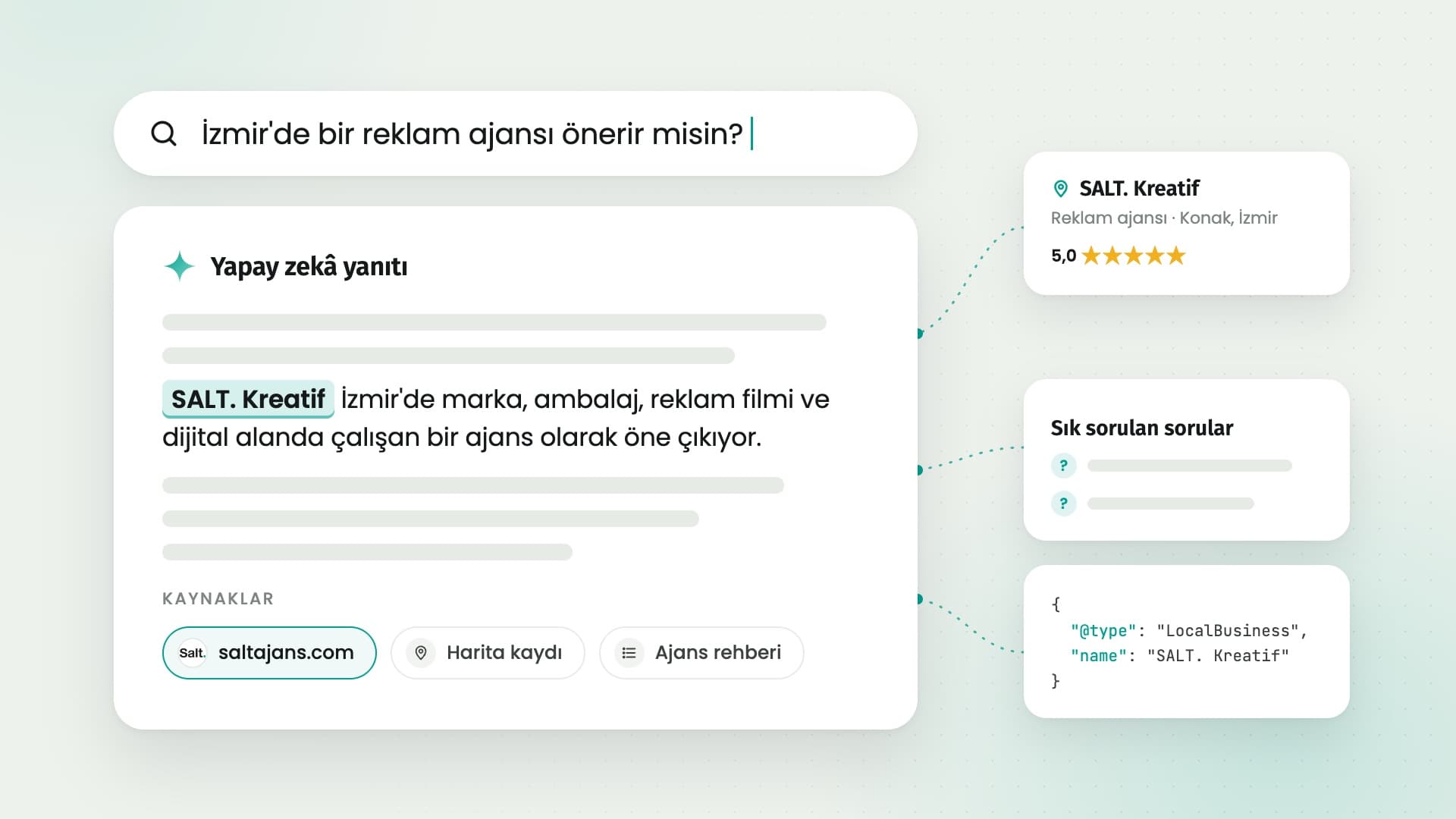
A few years ago, someone searching for “advertising agency in İzmir” would see ten blue links, click a few and compare. Today the same search often starts with a paragraph: Google's AI answers the question itself, names a handful of businesses and links to a few sites as sources. The same happens in ChatGPT, Gemini and Perplexity. People ask, the AI summarises, and the decision is often made inside that summary.
In this article we look at what has changed in search with Google's AI Mode and AI Overviews, why it matters to appear in AI answers, and the concrete steps you can take to make sure your brand does. At the end you'll also find how we at SALT. Kreatif run this work for our own brand and for our clients.
What has changed at Google? AI Mode and AI Overviews in Türkiye
On 18 February 2026, Google began gradually rolling out AI Mode and AI Overviews, powered by Gemini 3, in Türkiye. Both change the shape of the results page:
AI Overviews
show a short summary of the topic at the top of the results, along with links to the sources behind it.
AI Mode
turns search into a conversation: people ask follow-up questions and can search by voice or with a photo from their camera.
Behind both sits a technique called “query fan-out”. The AI breaks a complex question into sub-questions and runs many searches at once. A question like “I want packaging design for my olive oil brand; who should I work with in İzmir?” becomes separate searches about the packaging design process, cost, export labelling rules and agencies in İzmir. The answer is assembled from the results.
Advertising is moving too. Google has started showing ads inside AI Mode and is expanding the format country by country, while OpenAI is opening ChatGPT ads to markets beyond the US. In short, the AI answer is becoming a new shop window where brands compete for space, both paid and organic.
Why does it matter to appear in an AI answer?
In classic search, being on page two meant being invisible. In AI search the bar is even higher: if your name isn't in the answer, for most people you're not even on the list. They read the summary, look at the two or three brands it mentions and largely decide there.
These clicks are also worth more. According to Google, visits from results pages that show AI Overviews tend to be higher quality: people spend more time on the sites they click through to. A visitor arriving from an AI answer knows what they're looking for and is close to a decision.
This shift matters most for B2B brands, exporters and service companies. Buyers no longer type one-word searches; they ask long, conversational questions: “agency that makes 3D animation for industrial products”, “packaging design for a food brand exporting to the EU”, “corporate website design in İzmir”. Brands whose websites answer these questions clearly are the ones that end up in the answer.
Is SEO dead? No, SEO is the foundation of GEO
Adapting to AI search is called GEO (Generative Engine Optimization). The name is new, but the foundation is familiar. Google states clearly that there are no additional requirements or special optimisations needed to appear in AI Overviews or AI Mode: your page needs to be indexed and eligible to be shown with a snippet. The SEO basics we already know still apply: a crawlable site, internal links, a good page experience, important information in text form and an up-to-date Google Business Profile.
Where GEO differs is that it shifts the focus from ranking to being understood. Before an AI mentions a brand, it has to recognise it: who you are, what you do, where you are and why you can be trusted. It gathers this not only from your website but also from map listings, industry directories, news and customer reviews. If the information is the same everywhere, your brand finds its place in the answer. If it's scattered, the AI either skips you or describes you wrongly.
8 steps to get your brand into AI search
1. Make sure Google can see your site
Set up Google Search Console, submit your sitemap and check the indexing report regularly. Old URLs left without redirects, accidental “noindex” tags and 404 errors rule out pages the AI could otherwise use as sources.
2. Say who you are the same way everywhere
Your brand name, address, phone number and the one sentence that says what you do should be identical on your website, your Google Business Profile, your social accounts and in directories. AI systems match brands through this consistency. Different names or old addresses can make it look as if there were two separate businesses.
3. Answer your customers' questions on your site
Add frequently asked questions to your service pages, write headings as questions and give a clear answer in the first two sentences. Concrete questions such as “How long does packaging design take?” or “Is the ad budget included in the agency fee?” are exactly the kind of content an AI can quote directly.
4. Use structured data correctly
Schema.org markup such as Organization, LocalBusiness and Service describes your business to search engines in a machine-readable way. Google says it isn't required for AI features, but stresses that markup must match the visible text on the page. Well-built structured data helps your brand be recognised the same way everywhere.
5. Complete your map and business profiles
Google Business Profile, Apple Maps (Apple Business) and Bing Places are core sources for local search and voice assistants. Fill in your categories, services, opening hours and founding year, add photos and keep the information current.
6. Get others to talk about you
AI systems verify a brand not only through its own website but through independent sources. Profiles on industry directories such as Clutch, Sortlist and DesignRush, news in trade media, awards and links from partners' websites all confirm your brand from the outside.
7. Collect genuine customer reviews
Verified reviews on Google and in directories are a trust signal for both people and AI. When you ask for reviews, don't offer discounts or gifts and don't ask for a rating; ask clients you've worked with to describe their experience in their own words.
8. Measure and check regularly
Visits from AI Overviews and AI Mode appear in Search Console's Performance report under the “Web” search type. Beyond that, ask ChatGPT, Gemini and Perplexity questions about your industry once a month: does your brand come up, is it described correctly, which sources are shown? Close the gaps based on those answers.
Frequently asked questions
Do I need separate work to appear in AI search?
According to Google there are no extra requirements; the foundation is a well-built SEO setup. The difference lies in content that answers questions clearly and in your brand appearing consistently in sources beyond your own site.
Where does ChatGPT learn about my brand?
Chat-based AI tools answer with information gathered from web searches and their training data. Alongside your website, map listings, directory profiles, news and customer reviews are among those sources.
What is the difference between GEO and SEO?
SEO aims to get your site to the top of search results. GEO aims to get your brand mentioned correctly in the answer an AI writes and shown as a source. They aren't alternatives; GEO is built on top of SEO.
When will we see results?
Google usually processes technical fixes within a few weeks. The effect of directory profiles, reviews and content builds up over a few months.
At SALT, we make your brand visible in AI
SALT. Kreatif is an advertising and design agency based in İzmir. Whether we're telling a brand's story through identity, packaging, a commercial or a website, we now start every project with one question: is this brand described correctly in AI answers?
We did this work on our own brand first. We cleaned up our site in Search Console, redirected old URLs, set up structured data and question-and-answer content on our service pages. We updated our Google Business Profile and Apple Maps listings, added ourselves to Bing Places and prepared our profiles on Clutch, Sortlist and DesignRush. Now we apply the same method for our clients:
GEO and SEO audit
We map how your site appears today on Google and in AI answers.
Technical fixes
We fix indexing issues, redirects and structured data.
Question-led content
We write your service pages and blog around the questions your customers actually ask.
Business profiles and directories
We make your Google, Apple and Bing listings and your directory profiles consistent.
Review process
We set up a process so you can ask clients for reviews within the rules.
Monthly tracking
We monitor and report how your brand is mentioned in ChatGPT, Gemini and Google's AI answers.
If you're curious how your brand shows up in AI search, take a look at our digital marketing service or tell us about your project. Let's map where you stand together.